

Precisely Platform Australia & New Zealand
What is the Precisely Platform?
The Precisely Platform is a unified data management platform designed to bring together the capabilities organisations need to make their data more accessible, accurate, governed and useful.
Many organisations manage information across a mixture of enterprise applications, databases, cloud platforms, legacy systems and geographic information systems (GIS). These systems can contain duplicated records, inconsistent information and valuable data that is difficult to combine.
The Precisely Platform addresses these challenges by connecting data management capabilities through a shared platform foundation. This helps organisations establish trusted data for analytics, business operations and AI.
The platform combines core data capabilities with data enrichment, location intelligence and services designed to help organisations find, understand, govern and use their information.
What can the Precisely Platform help organisations achieve?
Connect enterprise data: Integrate information across different systems, applications and environments.
Improve data quality: Profile, validate and standardise records to improve accuracy and consistency.
Strengthen data governance: Understand data ownership, lineage, policies and business meaning.
Enrich business information: Add demographic, property, risk and other contextual datasets.
Apply location intelligence: Analyse geographic relationships, spatial patterns and location-based opportunities.
Establish trusted records: Create consistent master records for customers, products, suppliers and other important entities.
Support AI and analytics: Build a more reliable, contextual and governed data foundation for advanced analytics and AI applications.
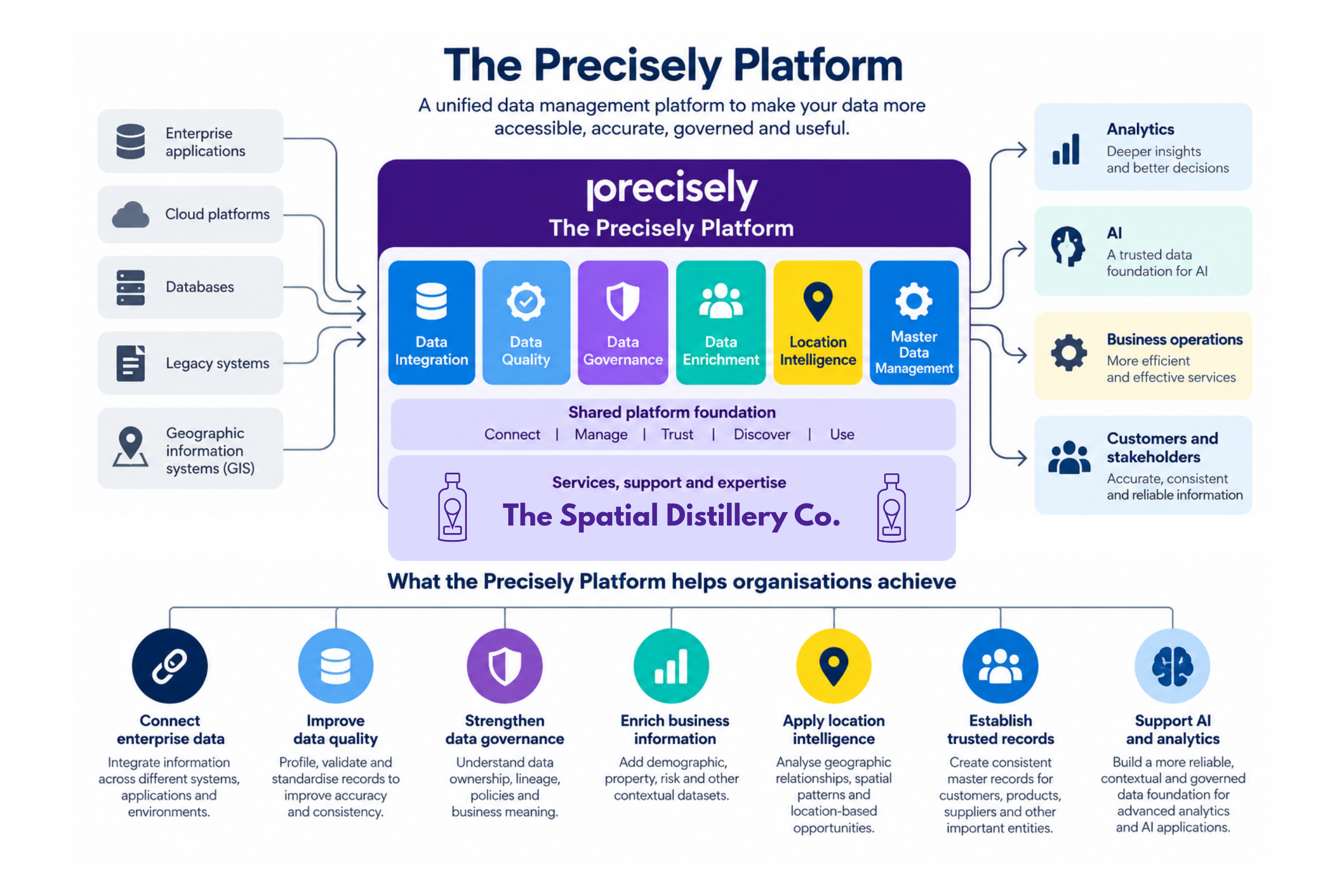
The platform's modular capabilities can address different data challenges while supporting a more connected approach to enterprise data management.
Unified data management, location intelligence and AI-ready data
Your organisation collects data from dozens of systems. But is that data accurate, connected, up to date and ready to use?
The Precisely Platform brings together data management, data quality, data integration, governance, enrichment and location intelligence to help organisations turn disconnected data into trusted, useful information.
For organisations across Australia and New Zealand, this means a stronger foundation for business intelligence, analytics, operational decision-making and artificial intelligence (AI).
The Spatial Distillery Co. helps Australian and New Zealand organisations understand, manage and get more value from their data through Precisely technology, data expertise, implementation services, consulting, training and support.
Whether you are exploring the Precisely Platform for the first time, modernising your data environment or looking to make your data AI-ready, this guide explains what it is, how it works and where it can help.
Want to discuss your data challenges? Talk to The Spatial Distillery Co. about your requirements and the Precisely solutions that may be right for your organisation.
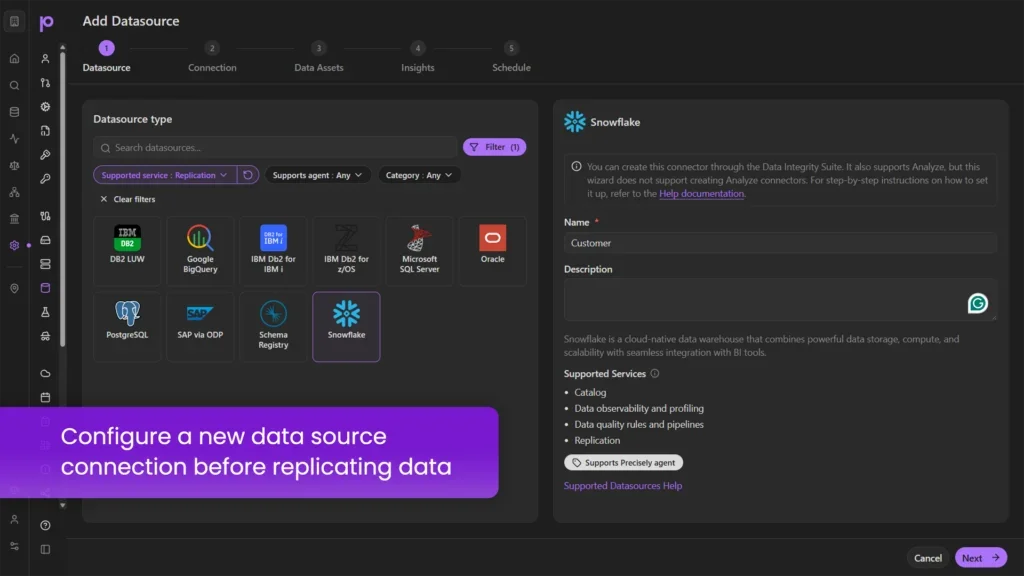
Data Integration
Connect information across your organisation.
Enterprise information is often distributed across cloud platforms, databases, legacy applications and operational systems. When these systems operate in isolation, information becomes difficult to share, reconcile and use consistently.
Data Integration connects these environments and moves information between systems, helping make data available to the people, applications and processes that depend on it.
Where it delivers value
Integrating data from multiple business systems.
Supporting automated data pipelines and workflows.
Making information available for reporting and analytics.
Reducing manual data transfers and disconnected processes.
Example: A telecommunications provider combines customer, address and network information from different systems to improve service analysis and operational planning.
Data Quality
Make business data accurate, consistent and fit for purpose.
Poor data quality affects everything that depends on information, from customer service and reporting to risk assessment and AI.
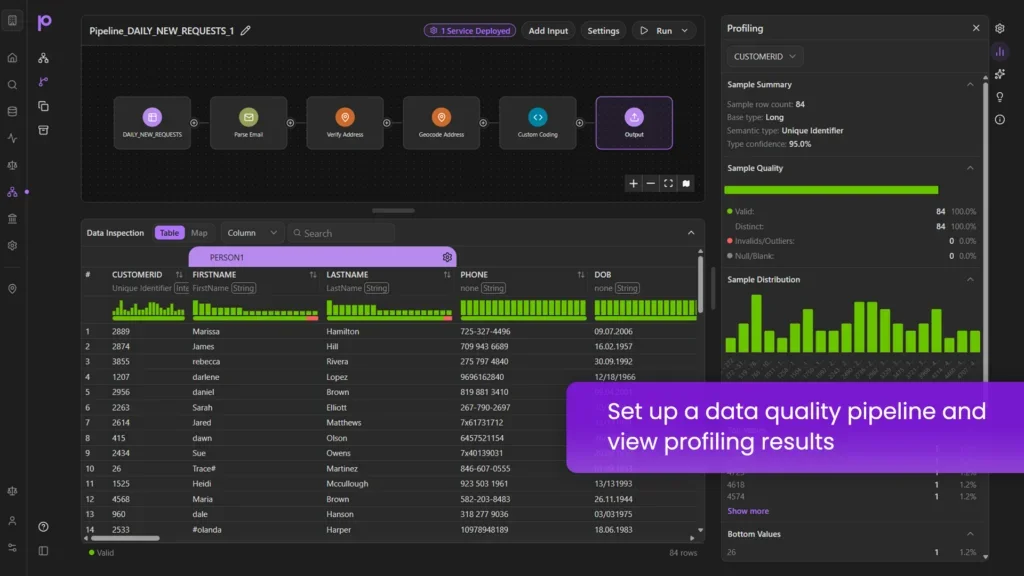
Data Quality capabilities help identify and address issues such as inconsistent formats, missing values, invalid records and duplication. Improving data quality makes information more reliable for operational use and analysis.
Where it delivers value
Validating and standardising address information.
Identifying duplicate customer or supplier records.
Improving the consistency of reporting datasets.
Establishing quality controls within data workflows.
Example: An organisation standardises address records and identifies duplicates before combining customer information from several business applications.
Data Governance
Know what your data means, where it comes from and who is responsible for it.
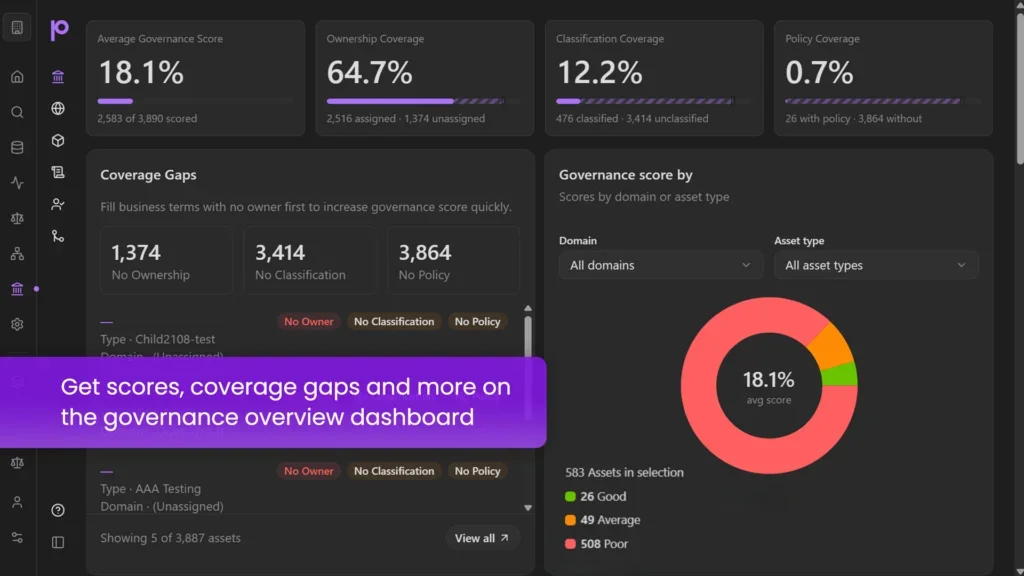
Data Governance provides the controls and visibility needed to manage information consistently across an organisation.
This includes understanding data ownership, definitions, lineage, metadata and applicable policies. These foundations help organisations assess the reliability of information and maintain accountability for how it is managed and used.
Where it delivers value
Establishing ownership and responsibility for critical datasets.
Understanding the origins and movement of data.
Improving transparency across reporting and analytics.
Supporting compliance and internal data management policies.
Strengthening oversight of data used in AI initiatives.
Example: A data team traces a reporting measure back to its source datasets and transformation processes, making it easier to investigate discrepancies and maintain confidence in the result.
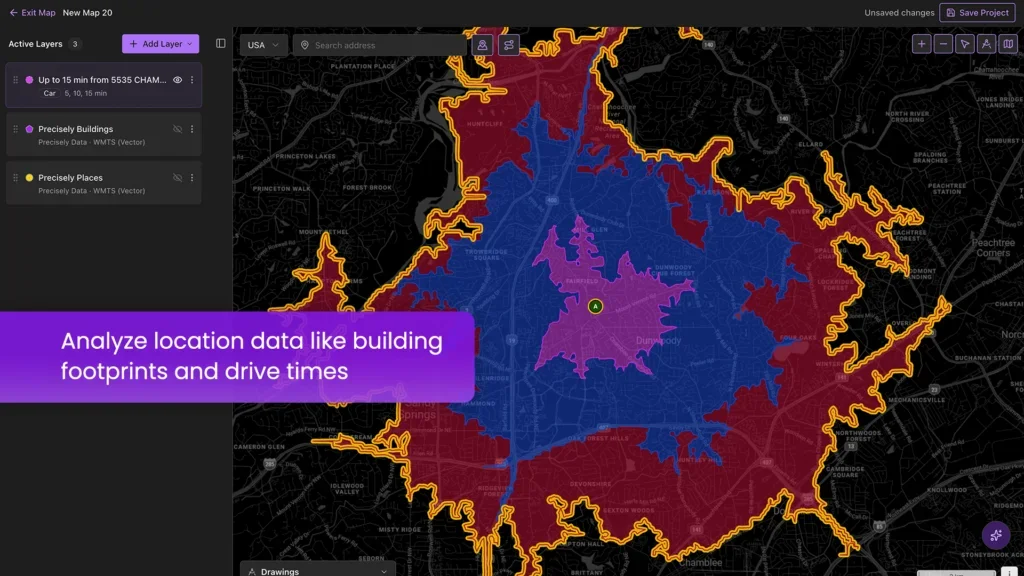
Location Intelligence
Put geographic context at the centre of your decisions.
Location is a powerful dimension of business data. It can reveal where demand is concentrated, how assets relate to their surroundings, which communities have access to services and where risks or opportunities exist.
Location Intelligence combines geographic information with business data and spatial analysis to uncover these relationships.
This capability is particularly relevant to organisations that make decisions about properties, customers, infrastructure, networks, service areas and the environment.
Where it delivers value
Analysing customer and market locations.
Understanding geographic service coverage.
Assessing property, infrastructure and environmental risks.
Supporting site selection and network planning.
Combining spatial datasets with enterprise reporting and analytics.
Example: A council combines property, population, infrastructure and environmental information to understand where services are needed and how investment priorities vary across its local government area. The Spatial Distillery Co. brings specialist spatial expertise to this area, helping organisations understand how GIS, location data and spatial analytics can support broader data management objectives.
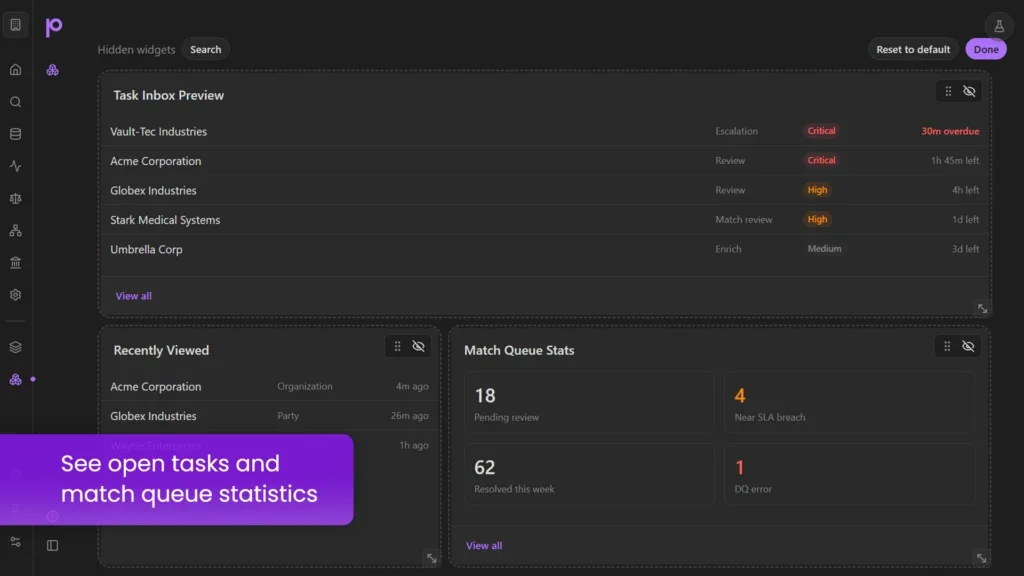
Master Data Management
Create a consistent view of critical business information.
Many organisations maintain multiple versions of the same customer, supplier, product or location across different applications. These inconsistencies can affect reporting, customer experiences and operational processes.
Master Data Management helps establish consistent, trusted records for important business entities and maintain alignment across systems.
Where it delivers value
Establishing consistent customer records.
Improving supplier and product information.
Reducing duplication across enterprise applications.
Supporting consistent business reporting and processes.
Example: A business reconciles customer records across CRM, finance and service systems to establish a more consistent view of each customer.
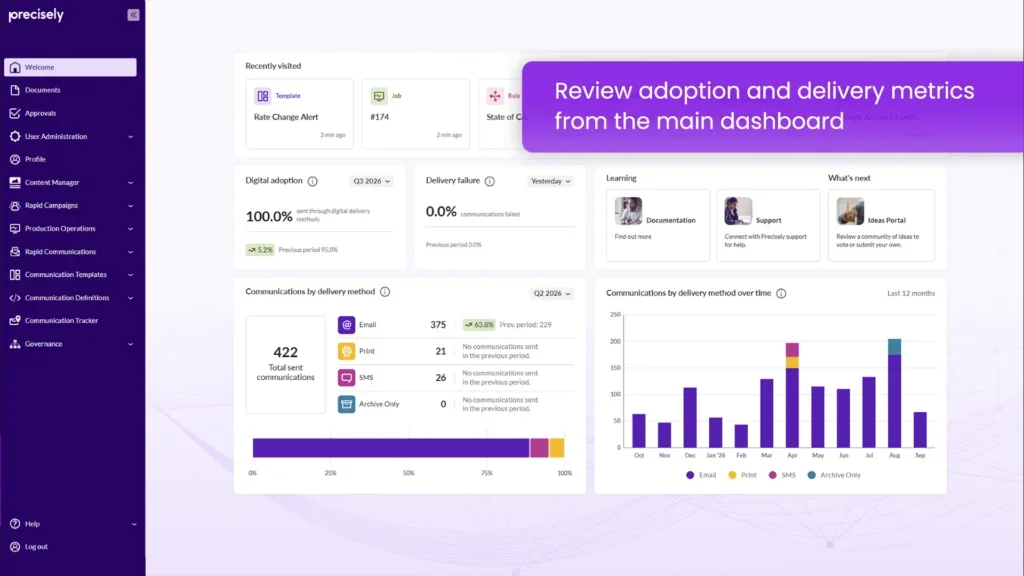
Customer Communications
Manage business communications with greater consistency and control.
Organisations that generate large volumes of customer correspondence need to ensure communications are accurate, consistent and appropriate for their intended audience.
Customer Communications capabilities support the creation and delivery of business communications using organisational data, templates and established business rules.
Where it delivers value
Producing statements, notices and customer correspondence.
Maintaining consistent communications across channels.
Applying controls to communication content and processes.
Supporting traceability and compliance requirements.
Example: A financial services organisation generates customer communications using approved templates and business information from its operational systems.
Frequently asked questions about the Precisely Platform
-
The Precisely Platform is a unified data management platform that brings together capabilities for data integration, data quality, data governance, location intelligence, master data management, customer communications and data enrichment. It provides a foundation for managing and using trusted enterprise data across business operations, analytics and AI initiatives.
-
The main capabilities include Data Integration, Data Quality, Data Governance, Location Intelligence, Master Data Management, Customer Communications and Data Enrichment. Supporting platform services include Catalog, Semantics, Observability, Pipelines, Workflow and AI Manager.
-
Data Integration connects information across systems and environments, helping make data available to applications, analytics platforms and business processes.
-
Data Quality capabilities help identify and address inconsistent, incomplete, invalid or duplicated records. This improves the reliability of information used for reporting, operations and analytics.
-
Data Governance helps organisations manage data ownership, definitions, lineage, metadata and policies. It improves visibility and accountability over how data is maintained and used.
-
Yes. Location Intelligence is a core capability that combines geographic information and spatial analysis with business data. It helps organisations understand geographic patterns, relationships, opportunities and risks.
-
Data Enrichment adds relevant external information to existing records. This can include address, property, demographic, geographic and other contextual data, depending on the products and datasets selected.
-
The platform's data integration, quality, governance and enrichment capabilities help organisations establish a more reliable foundation for AI. These capabilities can improve data accessibility, consistency and context, although successful AI also requires appropriate security, testing and oversight.
-
We help organisations understand Precisely technology, assess spatial and data requirement and explore relevant consulting, training and technical support. We can also help clarify how established Precisely products relate to the broader platform.
Talk to The Spatial Distillery Co. about Precisely
The Precisely Platform brings together important data management capabilities to help organisations connect information, improve quality, strengthen governance and make better use of location intelligence.
For organisations across Australia and New Zealand, the next step is identifying which capabilities align with your data environment and business priorities.
Speak with The Spatial Distillery Co. about Precisely Platform capabilities.